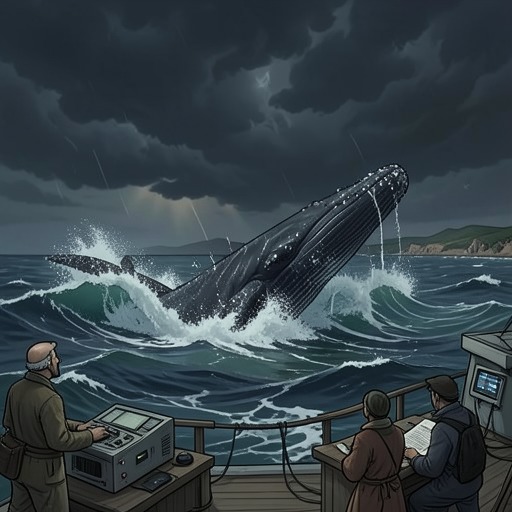
Thames River
The WhaleThe River Thames is more than a setting for the book’s history of whales: it is a route by which whale products entered the capital, a place where living cetaceans repeatedly strayed into human territory, and a stage on which changing attitudes toward them became visible. Its long record brings commerce and encounter into the same waterway. Whales arrived there as valuable cargo, as unexpected visitors, as public curiosities, and, in the modern period, as animals people tried to save.
A river in the whaling economy
The Thames connected the processing of whales to the city’s everyday life. At the river’s eastern bend, where its water widens toward the sea, whales were brought in and blubber was rendered. The industrial work was kept away from the most populated streets, but it remained part of the city’s material history. The site later occupied by the Millennium Dome is identified with this processing landscape: the river’s commerce carried the whale from open water into the machinery of urban consumption.
That trade also linked distant seas to places far from the Thames. In Nantucket, sperm-whale headmatter was heated, cooled, pressed, and re-pressed to produce spermaceti and, finally, white wax for candles. The first pressing yielded the purest sperm; later stages produced other grades of oil and wax. These procedures show how the whale’s body passed through a chain of labor and manufacture before its products reached consumers. The river stands at the urban end of that broader exchange, where marine extraction helped supply a city’s illumination and prosperity.
The text sets such wealth against its ecological cost. In its account of New Bedford, grand houses and gardens are described as having been drawn from the Atlantic, Pacific, and Indian oceans: each display of prosperity was tied to the death of a whale. The Thames-side rendering grounds make that transformation concrete. The river that carried commodities toward the city was also a place where the animal’s body was reduced to usable material.
Stranded whales and public spectacle
Cetaceans entering the Thames recur across several centuries, but their reception changes little at first: people gather, the animals are pursued or displayed, and their arrival is made to serve human purposes. In 1658, a right whale appeared in the river during a storm and drew a large crowd travelling by water, horse, coach, and on foot. John Evelyn recorded its capture and described measuring it at fifty-eight feet long. Its bones were later fixed beside the road to Colchester as a monument; the name Whalebone Lane preserved the episode in the landscape.
Other visitors were treated as resources or specimens. In 1788, twelve male sperm whales stranded in the estuary and were rendered for oil. Five years later, a harpooned orca was chased from Deptford toward Greenwich, and its skull entered the collection of the Royal College of Surgeons. In 1842, sailors from the Dreadnought Seamen’s Hospital-ship captured a small whale near Deptford Pier. It was brought ashore and displayed at a butcher’s shop. The river repeatedly brought animals into view, but visibility did not mean safety: a whale’s presence prompted pursuit, commercial use, or public exhibition.
In the 1880s, a bottlenose whale stranded near the Woolwich Arsenal. The steam tug Empress towed it from the beach while its crew sought advice about what to do with it. In 1918, a dolphin stranded at Battersea Bridge was eaten by museum correspondents, and some of its meat was served at a banquet. These episodes reveal an older relationship in which stranded cetaceans could be treated as food, research material, or spectacle. The river’s visitors were not yet consistently understood as animals whose own needs should govern human action.
From accusation to attempted rescue
The changing response becomes especially clear in 1961, when a sixteen-foot minke whale was found on the riverbank after apparently colliding with a boat. RSPCA inspectors, police officers, and other helpers moved it back into the water in a tarpaulin, hoping it would return to the sea. It became caught in reeds near Kew Bridge and died. Newspapers associated the whale with a nearby engineer’s drowning and with two boys whose boat had nearly been capsized; a photograph of men standing over the animal made it appear to be the accused party. The episode placed an emerging rescue impulse alongside an older tendency to cast a whale as a threat or omen.
The twenty-first-century visitor made that contradiction a national event. The northern bottlenose whale passed under Waterloo Bridge and Charing Cross, near the place where Herman Melville had stayed, and continued past the Palace of Westminster before stranding on the Battersea embankment. Crowds, boats, helicopters, and news crews followed its movement. The animal, accustomed to the open sea, was suddenly at the center of the city’s noise and attention; the effort to assist it became a global spectacle in its own right.
Rescuers placed the whale on an inflated pontoon and carried it back toward the sea, watched from the bridges by crowds and cameras. Its condition worsened during the journey. At seven that evening, near Gravesend and still two hours from freedom, it died. Those accompanying it asked for the cameras to be turned off. The request marked a quiet break with the spectacle surrounding the rescue, though it could not undo the pressures that had accompanied the animal through the river.
A waterway of changing meanings
The 2006 whale was interpreted in sharply different ways. Some treated the scenes as evidence of human compassion; others saw them as a reminder of the continuing violence of commercial whaling. The episode also recalled earlier public ceremonies surrounding stranded animals, including the display of a beluga at the Royal Aquarium. Across these incidents, the Thames makes the whale alternately a commodity, a specimen, a supposed omen, a public attraction, and an individual in distress.
This history gives the river a double significance. Its tidal passage once enabled the processing and circulation of whale products, drawing value from animals taken far beyond the city. Yet it has also repeatedly exposed the gap between the city’s confidence in managing nature and the vulnerability of whales caught within its built environment. In the final rescue, the Thames is at once a possible route back to the sea and a dead end: the attempt to return the whale to freedom ends short of the open water.